Book Recommendation: Probability Theory

One of the most useful areas in mathematics is probability, due to the constant uncertainty in which we live our lives and its ability to help us extract information about the past, present, and future. This is a fundamental area of specialization for anyone working in statistics, and especially in quantitative finance. I’ve read several books on probability and stochastic processes, but the ones I most highly recommend for truly diving deep and understanding what you're doing are the following.
Probability: An Introduction - Allan Gut
This book was originally conceived as an introductory text for first- and second-year mathematics courses at universities like Bristol, Oxford, and Cambridge, but its clarity also makes it highly suitable for students in Economics, Engineering, and Physics who have a serious interest in probability. I used this book when I told myself: "Alright, let’s study probability from scratch, with something solid, the way they do at Oxford."
The text is extremely compact yet rigorous—ideal for students who want a concise presentation without sacrificing depth. Although it doesn't rely on measure theory, it makes honest efforts to maintain mathematical rigor, and it clearly signals when more heuristic arguments are used. In that sense, it feels more like polished lecture notes than a lengthy textbook—which is intentional and advantageous for those following a course with a teacher.
Prerequisites include single-variable calculus, basic algebra, and some familiarity with logical and set notation. Measure theory is not required, but a degree of mathematical maturity is helpful to follow the more formal arguments. Still, the explanations are clear enough that any reader with the basics can follow along perfectly.
Some of the most important topics covered in this book—and which I recommend mastering—include:
Discrete and continuous random variables
Generating functions and moments
Convergence lemmas and limit theorems (weak law, CLT, large deviations)
Elementary stochastic processes: branching, random walk, and Poisson process
Discrete-time Markov chains and convergence
This book is an excellent foundational text for a rigorous undergraduate probability course or as a solid review before a master’s program. It’s also a great resource for self-learners with a strong background in mathematics.

An Intermediate Course in Probability - Allan Gut
I used this book during my MSc in Statistics & Operations Research at the Universitat Politècnica de Catalunya. It’s a very rigorous yet pedagogically friendly book. Gut devotes many pages to worked-out examples from different perspectives. The proofs are detailed but don’t require measure theory, making this book an excellent bridge to graduate-level material.
That said, a solid foundation in calculus, good command of linear algebra, and an introductory course in probability are necessary. The last two are usually standard for STEM and Economics students in Spain, although the depth of calculus training depends on the specific degree.
Some of the most important topics in this book—and which I recommend focusing on—include:
Multivariate random variables
Transformations and order statistics
Multivariate normal distribution
Weak and strong convergence
Poisson process
I would expect a postgraduate student to be fully comfortable with these topics.

Essentials of Stochastic Processes – Richard Durrett
This is one of the most complete treatises I’ve read for delving into measure theory with immediate applications to probability—truly a work of art and one of the most comprehensive texts in modern measure theory. I’ve been using it lately as a reference while preparing for my MSc at Warwick and my future PhD in probability and statistics. In particular, I’ve focused on the foundational measure-theoretic underpinnings of advanced probability and stochastic processes.
This is a deeply structured and demanding book. Unlike classical texts like Royden or Rudin, this one naturally integrates measure theory and mathematical probability right from the start. The authors begin with general foundations, including abstract measure spaces, measurable functions, and measure extensions, and then proceed to advanced topics such as convergence theorems (MCT, DCT, Fatou), L^p spaces, martingales, Poisson processes, Brownian motion, and modern tools like bootstrap methods and Markov Chain Monte Carlo (MCMC).
This book requires solid knowledge of real analysis, linear algebra, and prior exposure to formal probability (as seen in the other books above). It’s not for beginners, but ideal for MSc or PhD students who want to master the modern measure-theoretic approach to probability. I would also recommend it to anyone seeking a deep and rigorous mathematical foundation in probability.
Some of the most important topics I recommend mastering from this book are:
Construction of measures (Carathéodory’s theorem and Lebesgue-Stieltjes measures)
Convergence theorems and integration theory
L^p spaces, duality, and basic functional analysis
Measure-theoretic probability: independence, laws of large numbers, and CLT
Martingales, conditional expectation, and stopping theorems
Markov processes and Brownian motion
Bootstrap and mixing processes
This book doesn’t just present theory—it offers exercises that force readers to consolidate every concept with technical precision. Highly recommended for any serious student of mathematical statistics, theoretical probability, or quantitative finance. In my opinion, this is a book that creates true experts in the field. It’s excellent preparation for a PhD or higher-level coursework.

Essentials of Stochastic Processes – Richard Durrett
This book is a very accessible and modern introduction to the study of stochastic processes, with a practical and applied focus. It’s ideal for undergraduates in technical fields or MSc students in statistics, financial engineering, computer science, or operations research. Durrett teaches through real-world examples, often starting with intuitive explanations before introducing formal proofs.
It’s used in universities like Duke, Cornell, and Purdue, and is commonly assigned in applied statistics or queueing theory courses. The theoretical level is lower than that of Grimmett & Stirzaker (see below), and it does not require measure theory, making it a great first “serious” book on stochastic processes.
Students should have a solid understanding of basic probability, linear algebra, and calculus—although the use of the latter is not particularly advanced.
Some of the most important topics in this book—and which I recommend focusing on—are:
Discrete- and continuous-time Markov chains
Poisson processes
Renewal processes
Martingales (with applications in game theory and finance)
With this background, a student should be well-prepared to tackle real problems involving queueing, inventory systems, or stochastic decision models (though this should be nuanced—see "Stochastic Optimization and Reinforcement Learning" by Powell).

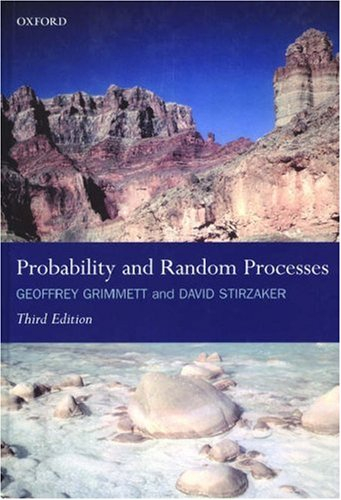
Probability and Random Processes - Geoffrey Grimmett & David Stirzaker
This is one of the most internationally recognized and widely used textbooks for advanced courses in probability and stochastic processes. It’s used in degrees at Oxford and Cambridge and is also part of the recommended reading lists for rigorous MSc programs and PhD preparatory courses.
Although intended for mathematics students, it’s also suitable for physicists, statisticians, and engineers with a strong mathematical foundation. The text is very formal but still accessible, and its structure supports progressive learning, with lengthy chapters, numerous examples, problems, and explanations that span from basic to advanced material.
To get the most out of it, one should have solid command of calculus (including sequences, continuity, and series), linear algebra, and an intermediate-level probability course.
Some of the most important topics in this book—and which I recommend exploring—are:
Discrete- and continuous-time Markov chains
Poisson and renewal processes
Martingales and limit theorems
Gaussian processes and Brownian motion
Applications in queueing, genetics, network systems, and information theory
This book serves as a reference for students seeking a solid theoretical foundation in probability, providing a gateway to research or high-level quantitative master’s programs.
Últimos Consejos
I truly believe that following these books—and in this specific order (except perhaps the third, on Measure Theory, which blends many topics from stochastic processes)—can comfortably bring anyone to a pre-PhD (or even in-PhD) level at a solid English-speaking university, provided they study and practice each book thoroughly.
Even if one only reads the theory and attempts a few exercises and examples, the difference in understanding compared to other students would be striking. These books are, in my opinion, a true bible for the subject—so use them!


Comments