Inequality of Opportunity and Education - Evidence

In the previous articles, I tried to introduce, in a simple way, what we mean by inequality of opportunity, as well as the most important transmission mechanisms and the economic and social consequences of inequality of opportunity. However, once the general idea has been defined, a much more concrete question remains: what does the empirical evidence tell us? In other words, when researchers try to measure this phenomenon with data, what do they find? To what extent does family background shape educational outcomes? What role does the school play? And what do we know about the Spanish case? This is what we now focus on. First, I will discuss the general evidence, and then I will focus on Spain, which is the case that interests me the most.
General evidence
The first conclusion from the literature is quite clear: family background matters. This may seem intuitive, but what is relevant is that it appears systematically across very different studies, countries, and datasets. Parents’ education, their occupation, the cultural resources available at home, and the socioeconomic environment are strongly related to children’s educational performance. In practice, this means that two students may be inside the same education system, but not really face the same opportunities.
Evidence from PISA data shows that a relevant part of the differences in academic performance can be explained by circumstances outside the student’s control. In Europe, Marrero, Palomino, and Sicilia find that the cultural environment at home and parents’ occupation are two of the most important factors explaining inequality of opportunity in educational achievement. Moreover, they show that these circumstances do not operate through a single channel, but through several: students’ educational and occupational expectations, reading habits, reading skills, and grade repetition. This means that it is not only about money, but also about expectations, information, habits, confidence, family references, and accumulated school experiences. A student may have talent and the willingness to make an effort, but if they do not properly understand what paths are available, if they lack close role models, or if they have internalised lower expectations, their educational decisions may be shaped from very early on.
Another relevant result is that not all countries combine quality and equality in the same way. Some education systems achieve good average results while also showing a weaker dependence on family background. Others, however, may have good average results but higher inequality of opportunity. This shows that educational inequality is not inevitable: it also depends on how education systems are organised, on their institutions, and on their policies.
Therefore, the general evidence suggests a simple but powerful idea: inequality of opportunity is an accumulative phenomenon. It does not suddenly appear at the end of someone’s educational or working life. It is gradually built, from childhood onwards, through small differences in resources, information, expectations, and experiences.
The Spanish case
Spain is a particularly interesting case because it combines several characteristics that, at first sight, may seem contradictory. On the one hand, it is a country with a broad education system, universal access to compulsory education, and many more formal opportunities than those available in other contexts. On the other hand, the empirical evidence shows that family background still has an important weight in educational, occupational, and economic trajectories. In other words, Spain is not a completely closed society, but neither is it a society where the starting point has stopped mattering.
In terms of inequality of opportunity in income, Cabrera, Marrero, Rodríguez, and Salas-Rojo estimate that in Spain, a very significant part of total inequality is associated with circumstances that people did not choose. Specifically, they find that inequality of opportunity represents around 44% of total inequality measured with the Gini index. In addition, they show that a large part of this inequality is explained by quite concrete factors: parents’ education and occupation, the type of school attended, the size of the household in which one grew up, and the gender of the household head. This is important because it suggests that family background influences not only educational outcomes, but also later economic position.

A particularly interesting result from this study is that Spain has experienced fairly high absolute educational mobility, but still maintains limited relative mobility. Put differently, many people have studied more than their parents, but the probability of reaching the highest educational levels still depends heavily on family background. According to the data in the study, the percentage of people with university studies is much higher when at least one parent also has university studies than when parents only have a basic education. This summarises one of the paradoxes of the Spanish case quite well: the system has expanded and has allowed many people to move upward relative to the previous generation, but the relative advantage of those who come from more educated families remains very strong.
When we look specifically at education, some comparative studies show that Spain has lower levels of inequality of educational opportunity than other European countries, especially some Central European countries. The report by Sicilia, Marrero, and Palomino for the “la Caixa” Foundation points out that Spain, together with the Nordic countries, is among the countries with lower inequality of educational opportunity measured with PISA data. But we need to be careful here. The fact that Spain performs relatively well compared with other countries does not mean that the problem does not exist. Rather, it means that educational performance seems to depend less on social origin than in some European countries, but not that it depends little in absolute terms, nor that the system works particularly well.
Moreover, Spain still carries other important problems. It may have relatively lower inequality of educational opportunity in PISA and, at the same time, problems of average performance, grade repetition, early school leaving, regional differences, and highly unequal educational trajectories. Therefore, it is important not to confuse two different things: relative equality in educational outcomes and the general quality of the system. A system can be somewhat less unequal than others and still fail many students.
In fact, grade repetition appears as one of the most relevant channels in the Spanish case. This is especially important because repeating a grade is not only an academic outcome: it can also affect the student’s self-esteem, expectations, and future decisions. If grade repetition is concentrated among certain social groups, it may end up reinforcing previous inequalities rather than correcting them. The problem is that, very often, the institutional response to these issues does not consist of addressing the underlying causes, but of modifying the statistics. If standards are lowered so that there are fewer repeaters, but learning does not actually improve, we may end up confusing an administrative improvement with an educational improvement. In Spain, we usually call bread for today and hunger for tomorrow.
Another key aspect is the territorial dimension. Spain does not function as a single homogeneous space of opportunity. The autonomous communities have important powers in education, and there are differences in resources, outcomes, policies, the social composition of schools, and available opportunities. But, in addition, recent evidence on intergenerational mobility shows that territorial differences are not limited to the education system. Soria and Medina, using administrative data that link millions of parents and children over more than two decades, find that opportunities for social advancement vary greatly depending on where a person grows up.
Their results place Spain in a lower-middle position in intergenerational income mobility. We are not looking at a case of extreme immobility, but neither are we looking at a particularly mobile country. According to their estimates, a 10-percentile increase in parents’ income rank is associated with a 2.74-percentile increase in the adult income rank of their children. In addition, the probability of moving from the poorest quintile to the richest quintile is 10.4%. This means that upward mobility is possible, but not equally likely for everyone.

One of the most striking results of the study is the strong persistence at the top of the distribution. In Spain, children from families in the top 1% are much more likely to end up in the top 1% themselves than children from families in the lower part of the distribution. This is relevant because we often talk about social mobility by thinking only about those who are born at the bottom and manage to move upward, but mobility also has to do with the ability of elites to reproduce themselves. If those at the top fall very little and those at the bottom move up with difficulty, then society may seem open in theory, while being quite closed in practice.
The geographical dimension reinforces this idea. Soria and Medina show that the areas with higher upward mobility are concentrated mainly in the north and northeast, including Catalonia, part of Aragón, Madrid, and some nearby provinces. By contrast, the areas with lower mobility are especially concentrated in Andalusia, Extremadura, and the Canary Islands. This suggests that opportunities do not depend only on the family, but also on the municipality, the autonomous community, the neighborhood, and the economic environment in which a person grows up.
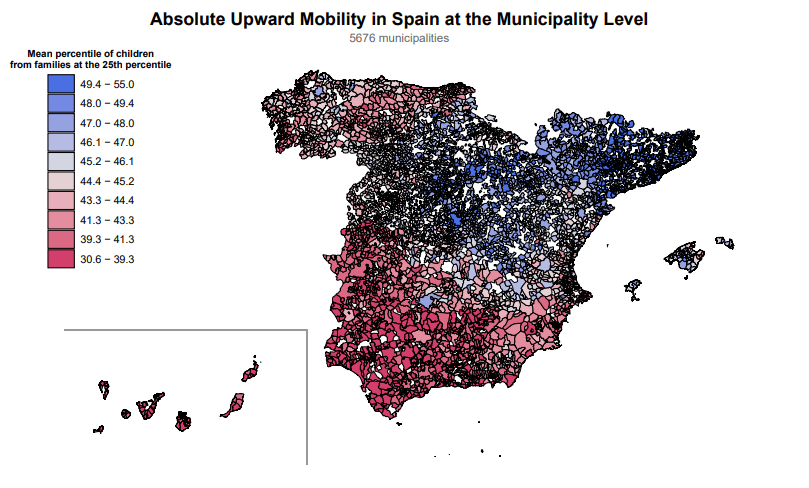
We often talk about “the Spanish education system” or “social mobility in Spain” as if all students moved within the same reality. But the concrete experience of a student depends on many layers: their family, their school, their teachers, their classmates, their neighbourhood, their autonomous community, the local labour market, and the information they receive at key moments. For this reason, inequality of opportunity is a matter of context.
Taken together, the evidence points to a fairly clear conclusion: Spain has improved a lot in educational access and has allowed many people to reach higher levels of education than their parents, but family background still strongly shapes trajectories. Education matters, but not everyone arrives at it with the same tools. Territory matters, but not everyone grows up in places with the same opportunities. And the labour market matters because it can amplify or block the advantages accumulated during childhood and youth.
Therefore, the relevant question is not only whether Spain offers formal opportunities. The question is whether those opportunities can be recognised, understood, and used by students from different social and territorial backgrounds. Because if opportunities exist, but only some people know how to use them or have the conditions to do so, then inequality of opportunity is still there, even if it is less visible.
What can we learn from this evidence?
The empirical evidence does not tell us that effort does not matter, because that would be absurd. It tells us that people make an effort within contexts that can greatly facilitate or hinder their decisions. A student with family support, clear information, and high expectations may interpret the education system as a set of possible paths. Another student, just as capable, may see it as something confusing, distant, or risky. In theory, both have access to the same system. In practice, they do not necessarily have the same tools to take advantage of it.
That is why I believe information asymmetry deserves much more attention. If a scholarship exists but some students do not know about it, if an educational pathway is good but many families do not understand it, if a decision made at fifteen or sixteen heavily shapes the future but is made with little guidance, then formal equality of access is not enough.
Moreover, the evidence reviewed shows that family background matters, that education is a central channel in the transmission of inequalities, and that Spain, although it has some relatively positive results in European comparison, still faces important problems. Especially in grade repetition, regional differences, social mobility, and student guidance.
The main conclusion is that education remains one of the most powerful tools for expanding opportunities, but it does not do so automatically. For it to work as a true mechanism of social mobility, it is not enough for the doors to be open. It is also necessary for all students to know that those doors exist, to understand how to cross them, and to have the real conditions to do so. At the end of the day, this is the issue that interests me the most: not only whether the system offers opportunities, but whether all students can recognise and use them effectively. Because if opportunities exist only for those who know how to find them, then inequality of opportunity remains present, even if in a less visible form.
References
Cabrera, L., Marrero, G. A., Rodríguez, J. G., & Salas-Rojo, P. (2021). Inequality of opportunity in Spain: New insights from new data. Hacienda Pública Española / Review of Public Economics, 237(2), 153–185. https://doi.org/10.7866/HPE-RPE.21.2.6
Calo-Blanco, A., & Villar, A. (2010). Quality of education and equality of opportunity in Spain: Lessons from PISA. Fundación BBVA, Documento de Trabajo 6/2010.
Chetty, R., Hendren, N., Kline, P., & Saez, E. (2014). Where is the land of opportunity? The geography of intergenerational mobility in the United States. NBER Working Paper No. 19843. https://doi.org/10.3386/w19843
Marrero, G. A., Palomino, J. C., & Sicilia, G. (2024). Inequality of opportunity in educational achievement in Western Europe: Contributors and channels. The Journal of Economic Inequality, 22, 383–410. https://doi.org/10.1007/s10888-023-09595-5
Sicilia, G., Marrero, G. A., & Palomino, J. C. (2022). Inequality of opportunity in educational performance in Spain and Europe: The role of expectations, reading skills and repetition as determinants of inequalities. “la Caixa” Foundation, The Social Observatory.
Soria, J., & Medina, O. (2025). Intergenerational mobility in Spain: Geographic analysis and causal neighborhood effects. World Inequality Lab Working Paper No. 2025/12.
Suárez Álvarez, A., & López Menéndez, A. J. (2025). The role of family background and education in shaping inequalities: Evidence from the Spanish regions. Social Policy and Society, 24(2), 355–372. https://doi.org/10.1017/S1474746423000179


Comments